A Tabata workout is a set of intervals: 20 seconds of very hard work and 10 seconds of rest, eight times through, which takes four minutes. The name comes from a 1996 study in Japan, where fit young men did those intervals on an exercise bike, flat out. Today the name is used for any 20 and 10 interval done eight times, usually with bodyweight moves and at a lower intensity than the study.
Where does the name come from?
It comes from Izumi Tabata, the lead author of a paper published in 1996 in Medicine & Science in Sports & Exercise. He and his colleagues at the National Institute of Fitness and Sports in Kagoshima compared two ways of training on an exercise bike over six weeks.
The first group trained the traditional way, with an hour of steady cycling at 70% of their VO2max, five days a week. VO2max is the most oxygen your body can use, and it's a common measure of aerobic fitness.
The second group, seven young men, did the intervals. They pedalled for 20 seconds at about 170% of their VO2max, far harder than the body can fuel with oxygen alone, then rested for 10 seconds, and repeated this until they couldn't keep the pedals turning fast enough. A supervisor encouraged them to complete seven or eight bouts, about four minutes in all. They did this four days a week, and on the fifth day rode for 30 minutes at a moderate pace before four of the hard bouts.
They were young male physical education students, most of them on university sports teams.
What did the Tabata study find?
The intervals improved two kinds of fitness, and the steady cycling improved one. The researchers measured VO2max and anaerobic capacity, which is how much energy your muscles can produce without oxygen in a short, hard effort.
- Steady cycling: VO2max rose from an average of 53 to 58 ml/kg/min. Anaerobic capacity didn't change significantly.
- Intervals: VO2max rose by 7 ml/kg/min, and anaerobic capacity went up by 28%.
The authors concluded that hard intervals could improve both energy systems, while the moderate training only improved the aerobic one.
What didn't the study show?
- It was small and specific. The interval group had seven people, all young, fit and male. It says nothing directly about women, older adults or beginners.
- It was on a bike in a lab. The effort was set from each person's measured VO2max. It didn't test squats, burpees or any bodyweight circuit.
- It wasn't only four minutes. The interval group trained five days a week, and one of those days included 30 minutes of steady cycling.
- It didn't measure fat loss. The study looked at VO2max and anaerobic capacity, not body weight or body fat.
- It lasted six weeks. It can't say what happens over months or years.
None of this means the format doesn't work, but the study tested something narrower and more extreme than most workouts that now carry the name. Our guide to whether the 7-minute workout works looks at another famous short workout the same way.
How do people use Tabata now?
Mostly as a timer. Fitness classes and apps use the 20 seconds on, 10 seconds off pattern with all sorts of moves, from squats and burpees to kettlebell swings, usually as a few four-minute blocks with a short rest between them.
Those sessions are usually a lot easier than the study's intervals. In 2013, researchers at the University of Wisconsin-La Crosse tested a 20-minute bodyweight and plyometric Tabata session (four 4-minute blocks, with a minute's rest between them) on 16 trained volunteers. Their heart rate averaged about 86% of maximum, and from that the researchers estimated they were working at about 74% of VO2max. The participants rated it as hard, but that's a long way below the 170% of VO2max in the original study.
So the original study's results don't carry straight over to a home session. If you wear an Apple Watch, our heart-rate zones guide explains what those numbers mean in a short workout.
A sample bodyweight Tabata session
This session uses two Tabata blocks, each alternating two moves, so your legs get a short break every other round. It takes about 17 minutes with the warm-up and cool-down.
Aim for the last two rounds of each block to feel tough without your form falling apart. If you can't manage the eighth round, you started too fast.
-
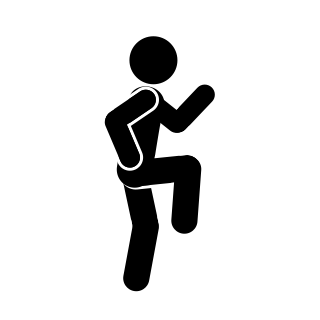 High knees
Run on the spot, driving your knees up to hip height and pumping your arms.
-
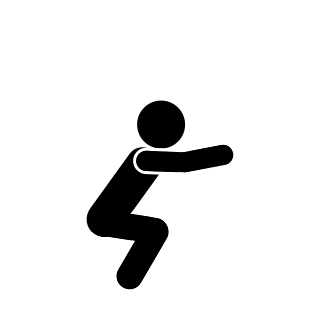 Speed squat
Squat as fast as you can with good form, standing all the way up each time.
-
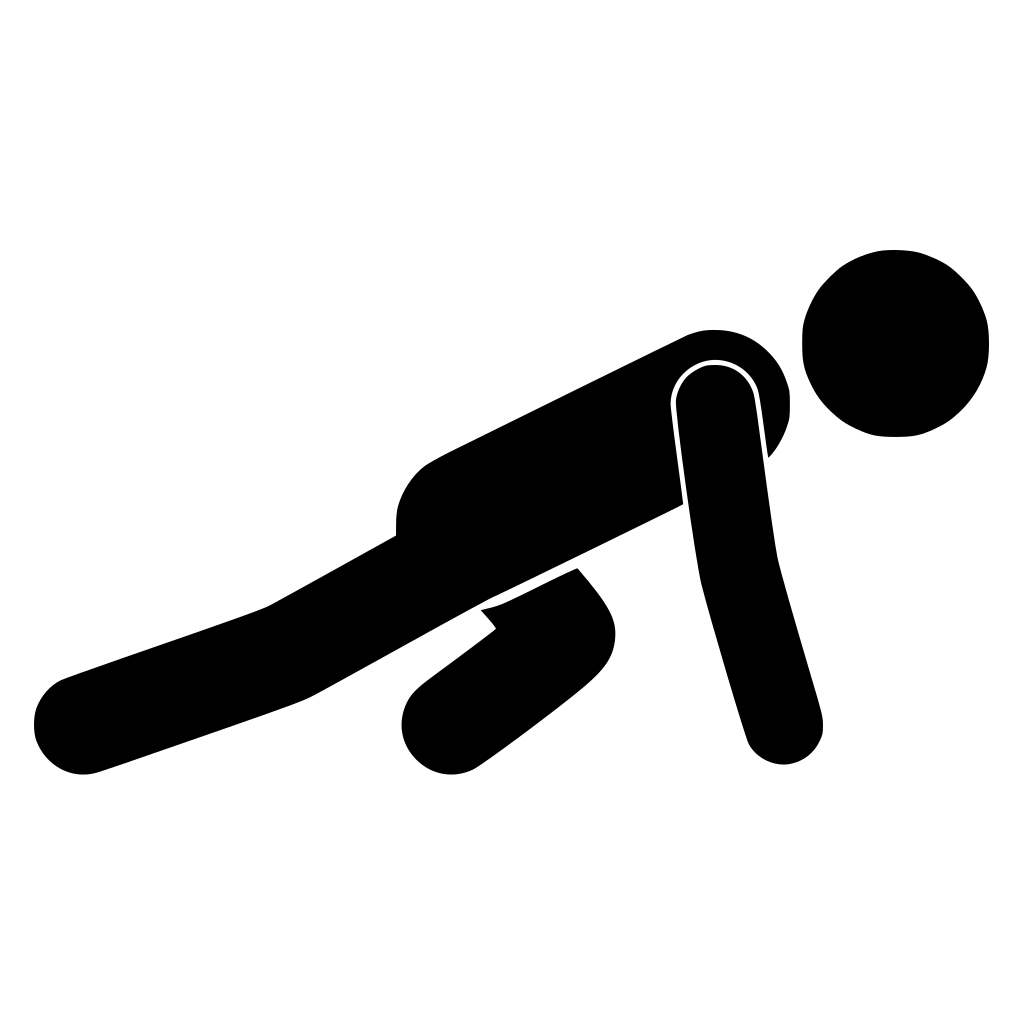 Mountain climbers
From a high plank, drive your knees towards your chest one at a time, hips low.
-
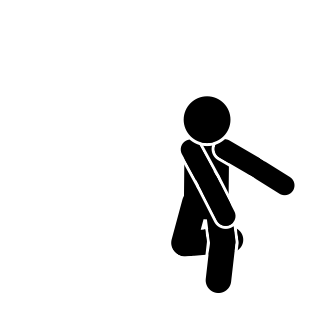 Skater jumps
Jump sideways from one foot to the other, swinging your arms, and land softly.
| Part | Time | What to do |
|---|---|---|
| Warm-up | 5 min | March on the spot, circle your arms, do 10 slow squats, then 30 seconds of easy high knees. |
| Block 1 | 4 min | Eight rounds of 20 seconds of work and 10 seconds of rest. High knees in rounds 1, 3, 5 and 7, speed squats in rounds 2, 4, 6 and 8. |
| Rest | 1 min | Walk around and get your breath back. |
| Block 2 | 4 min | Same timing. Mountain climbers in the odd rounds, skater jumps in the even rounds. |
| Cool-down | 3 min | Walk until your breathing settles, then stretch your calves, thighs and hips. |
Don't skip the warm-up, because the first round asks for a big effort straight away. Our guide on how to warm up before a home workout has a longer one.
To keep the noise down, march instead of running on the spot and swap the skater jumps for side lunges (our quiet, no-jump workout guide has more swaps). When the session feels easy, add a third block, and read our plyometrics guide before adding harder jumps.
Who should be careful with Tabata?
Anyone who isn't used to hard exercise. Tabata is meant to push your heart rate and breathing close to their limit.
If you have a heart or blood pressure condition, an injury, or you haven't exercised in a while, check with your doctor before you start high-intensity intervals. Stop if you feel chest pain, dizziness or faintness, or you're more short of breath than the effort explains. And if a move hurts a joint, swap it for a low-impact one, such as marching in place of high knees.
The Heart Pounder pack
Heart Pounder is a Workout Pack in Streaks Workout with 10 high-intensity moves and four interval workouts. Tabata Trio is its Tabata workout: three blocks of 20 seconds flat out and 10 seconds of rest, eight times through, with a minute's rest between the blocks. Each block sticks to one move, starting with skater jumps, then cross-body mountain climbers, then speed squats. It takes about 14 minutes, and it doesn't include a warm-up, so do your own first.
-
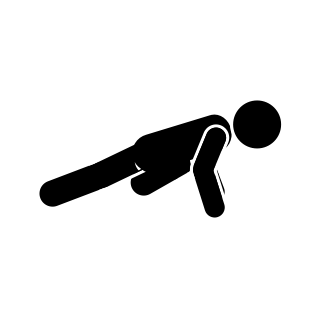 Cross-body mountain climber
A mountain climber where each knee drives towards the opposite elbow. Keep your hips low.
If that's too much to begin with, Starter Sweat is the pack's easy workout, with 30 seconds on and 30 off over three rounds of five moves. Quick Burn and Max Effort step up from there, with more work and less rest. You can also add the pack's moves to your own workouts in the app.
Common questions
How long is a Tabata workout?
One Tabata block takes four minutes: eight rounds of 20 seconds of work and 10 seconds of rest. Most home sessions do two to four blocks with a minute's rest between them, plus a warm-up and cool-down.
Is Tabata the same as HIIT?
Tabata is one kind of high-intensity interval training (HIIT), with fixed timing: 20 seconds of work and 10 seconds of rest, eight times. HIIT covers any workout that alternates hard efforts with recovery, at any timing, such as 30 seconds on and 30 off.
Is Tabata good for beginners?
It can be, if you choose moves you can do well and pace yourself to last all eight rounds. Start with one or two blocks of low-impact moves, such as marching on the spot and squats. If you have a heart or blood pressure condition or an injury, or haven't exercised in a while, check with your doctor first.
Does Tabata burn fat?
The original study didn't measure body fat or weight, so it can't tell you. A Tabata session is hard work and counts towards your weekly exercise, like any other workout, but there's no special fat-burning effect behind the name.
How often can you do Tabata?
Twice a week is a sensible start. The American Council on Exercise suggests leaving 48 to 72 hours between sessions if you do two a week. On the other days, walk, stretch or do an easier workout.
Sources
- Tabata I, Nishimura K, Kouzaki M, Hirai Y, Ogita F, Miyachi M, Yamamoto K. Effects of moderate-intensity endurance and high-intensity intermittent training on anaerobic capacity and VO2max. Medicine & Science in Sports & Exercise. 1996, 28(10), pages 1327 to 1330. PubMed, doi:10.1097/00005768-199610000-00018
- Emberts T, Porcari J, Dobers-Tein S, Steffen J, Foster C. Exercise intensity and energy expenditure of a Tabata workout. Journal of Sports Science and Medicine. 2013, 12(3), pages 612 to 613. PubMed
- Dalleck LC. Ask ACE: how to maximize your high-intensity interval training workouts. American Council on Exercise, Certified, June 2025. acefitness.org
More guides
Short home workouts with voice coaching, plus the Heart Pounder pack of high-intensity intervals, including the Tabata Trio workout. A one-time purchase, with no subscription.