You can stretch your neck, shoulders, wrists, back and hips in about five minutes without leaving your desk. Start in your chair with slow neck rolls and shoulder and wrist stretches, then stand up for a side bend, a hip flexor stretch and a calf stretch. Do it a few times a day, whenever you've been sitting for a while, and keep every stretch gentle.
Why stretch at your desk?
Mostly because it gets you out of the chair. Sitting in one position for hours leaves a lot of people feeling stiff, and a few minutes of moving around usually feels better. The stretches give the break a shape, so it's more than a trip to the kitchen.
Be wary of big promises, though. Stretching won't undo a day of sitting on its own, and the American College of Sports Medicine notes that the link between flexibility and fewer injuries hasn't been shown. The guidelines on sitting are about getting up and moving more often, even gently.
How often should you get up from your desk?
As often as you reasonably can. Australia's movement guidelines for adults recommend limiting the time you spend sitting and breaking up long periods of it as often as possible. The World Health Organization's 2020 guidelines say the same, and add that replacing sitting with activity of any intensity, including light activity, has health benefits.
Neither sets a number. The WHO guidelines say there wasn't enough evidence to say how often or how long the breaks should be. So pick prompts that already happen in your day: the end of a call or meeting, refilling your water, or waiting for something to upload. If you wear an Apple Watch, its Stand ring fills when you stand and move for at least a minute in an hour, which is a handy nudge. Our guide to closing your Move ring at home explains the rings in more detail.
You don't need to do the whole routine every time. A minute of neck rolls and a calf stretch counts as getting up.
How do you stretch your neck and shoulders at a desk?
Sit tall on the front half of your chair with your feet flat, and move slowly. These three work sitting or standing.
-
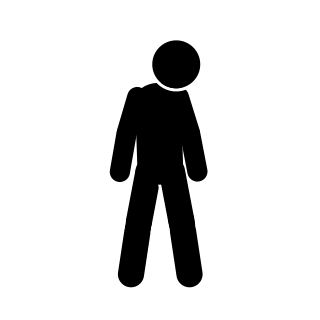 Neck rolls
Drop your chin towards your chest, then roll your head slowly so one ear moves towards its shoulder. Roll back through the middle and over to the other side. Keep it to a half circle in front of you rather than letting your head drop back, and never force the range.
-
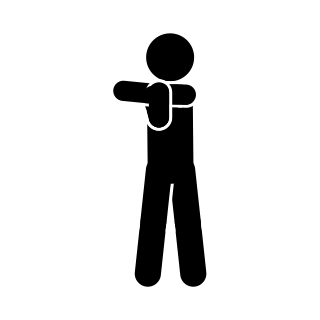 Cross-body shoulder stretch
Bring one arm straight across your chest and hold it just above the elbow with your other hand. Pull it gently towards you until you feel the back of the shoulder. Keep both shoulders down, away from your ears.
Before those, try a few shoulder rolls: lift your shoulders towards your ears, squeeze them back and let them drop. Ten slow ones, going backwards, are a good way to start.
How do you stretch your wrists and forearms?
Circle them first, then stretch each forearm with your arm held out straight. If you type or use a mouse all day, this is the part you'll notice most.
-
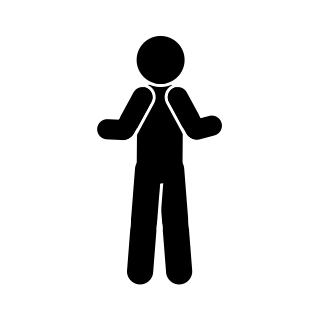 Wrist circles
Interlace your fingers in front of you and draw slow circles with your hands. Change direction halfway through. Stop if you feel any sharp pain.
For the forearm stretch, hold one arm out in front of you, palm up. With your other hand, gently pull the fingers down and back until you feel a stretch along the inside of your forearm. Hold, then turn the palm down and press the back of the hand to stretch the outside. Swap arms.
How do you stretch your back without lying on the floor?
A seated twist and a standing side bend cover most of it, and neither needs any floor space.
For the seated twist, sit tall with your feet flat and turn your chest to one side, holding the back or armrest of the chair. Turn from your ribs rather than cranking your neck, and look over your shoulder only as far as is comfortable. If your chair swivels, hold the edge of the desk instead so the chair doesn't turn with you.
-
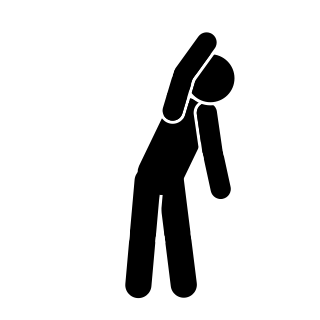 Standing side bend
Stand tall with your feet hip width apart. Reach one arm overhead and bend slowly to the other side, keeping your hips still and facing forward. Come back to the middle and bend the other way.
How do you stretch your hips after sitting?
Stretch the front of the hip, which spends the whole day bent when you sit. Do it kneeling if the floor next to your desk is clean, or standing if it isn't.
-
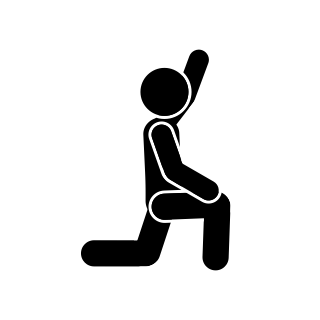 Hip flexor stretch
Kneel on one knee with the other foot flat in front of you. Squeeze the glute on the kneeling side and tuck your tailbone under until you feel a stretch at the front of that hip. Reach the arm on the kneeling side overhead. To do it standing, take a long step forward, keep the back leg straight and do the same tuck and squeeze.
-
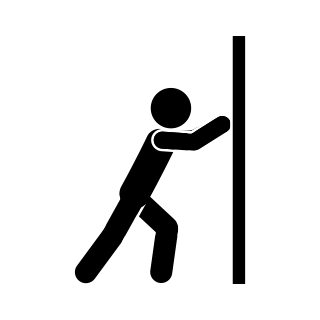 Calf stretch
Put your hands on a wall or the edge of a solid desk and step one foot back. Keep that leg straight and press the heel down until you feel the stretch in your calf. Bend the back knee slightly to feel it lower down.
A 5-minute desk stretch routine
Here's the whole thing in order. The first six are done sitting, and the last three standing. Move slowly between them, and if you only have two minutes, do the first three and the last one.
| Move | Time | Notes |
|---|---|---|
| 1. Neck rolls | 30 s | Half circles in front, both directions. |
| 2. Shoulder rolls | 20 s | Slow, rolling backwards. |
| 3. Cross-body shoulder stretch | 20 s each side | Shoulders down. |
| 4. Wrist circles | 20 s | Change direction halfway. |
| 5. Forearm stretch | 15 s each arm | Palm up, then palm down. |
| 6. Seated twist | 20 s each side | Hold the desk if your chair swivels. |
| 7. Standing side bend | 30 s | Alternate sides slowly. |
| 8. Hip flexor stretch | 25 s each side | Kneeling or standing. |
| 9. Calf stretch | 20 s each side | Hands on the wall or desk. |
For a longer stretch at the end of the day, our guide to yoga for beginners at home has a short flow on the floor. If you're stretching to get ready for exercise rather than to break up sitting, see how to warm up before a home workout instead, as a warm-up should get you moving more than this does.
How far should a stretch go?
Only to where you feel a mild pull. The American College of Sports Medicine suggests stretching to the point of tightness or slight discomfort and holding for 10 to 30 seconds for most adults, which is why the holds above are short. Breathe normally, and ease into each stretch rather than bouncing.
Stop if anything feels sharp, or if neck rolls make you dizzy. Desk stretches are for ordinary stiffness. If you have pain that doesn't settle, an injury, or numbness, tingling or weakness in your arms, hands or legs, see a doctor or physio rather than stretching through it.
The Limber Up pack
Limber Up is a Workout Pack in Streaks Workout with 13 stretches, each with its own animation, and four workouts. One of them, Desk Reset, is a short desk break built from five of the moves in this guide: neck rolls, the cross-body shoulder stretch, wrist circles, the standing side bend and the hip flexor stretch. The app times each stretch and tells you what's next, so you can follow along without reading a list.
The other three use the floor: Lower Body Release (long holds for hamstrings, quads, calves and hips), Hips & Spine (slow hip openers and twists for stiff days) and Cool-Down (easy stretches after a workout). None of them need equipment. If you're new to exercising at home, our guide to starting to work out at home is a good next step, and the quiet, no-jump workouts suit a lunch break when other people are around.
Common questions
Can you do desk stretches without standing up?
Yes. The neck, shoulder, wrist and twist stretches all work sitting down. Standing up for the last few is worth it if you can, because getting out of the chair is part of the point.
How long should you hold a stretch?
The American College of Sports Medicine suggests holding a stretch for 10 to 30 seconds for most adults, at the point where you feel tightness or slight discomfort. The holds in the routine above are 15 to 25 seconds.
Is it OK to do desk stretches every day?
Yes, gentle stretches like these are fine to do every day, and several times a day. Keep each one to a mild pull, and skip any that hurt.
Should you stretch if your neck or back hurts?
These stretches are for the stiffness that comes from sitting, not for treating pain or an injury. If you have pain that doesn't settle, or numbness, tingling or weakness in an arm or leg, see a doctor or physio first.
Sources
- Australian Government Department of Health, Disability and Ageing. Recommendations for adults (18 to 64 years). Updated 3 June 2026. health.gov.au
- Bull FC, Al-Ansari SS, Biddle S, et al. World Health Organization 2020 guidelines on physical activity and sedentary behaviour. British Journal of Sports Medicine, 2020, 54(24): 1451-1462. pmc.ncbi.nlm.nih.gov
- Garber CE, Blissmer B, Deschenes MR, et al. American College of Sports Medicine position stand: quantity and quality of exercise for developing and maintaining cardiorespiratory, musculoskeletal, and neuromotor fitness in apparently healthy adults. Medicine & Science in Sports & Exercise, 2011, 43(7): 1334-1359. pubmed.ncbi.nlm.nih.gov
- Kravitz L. From 1998 to 2011: ACSM publishes updated exercise guidelines. University of New Mexico. unm.edu
- Apple. Track daily activity with Apple Watch. Apple Watch User Guide. support.apple.com
More guides
Short workouts with voice coaching, plus the Limber Up pack for stretching breaks at your desk. A one-time purchase, with no subscription.